San Martino is a small church perched on the mountain side above Griante, Lake Como. It's official name is "Santuario Della Madonna delle Grazie di San Martino", but most everyone simply refers to it as San Martino.
Once we arrived at the church of San Martino, we were rewarded with spectacular views of Lake Como. From the small plateau on which the church sits, we were able to see Bellagio, the town of Griante directly below, and the large mountains that line the eastern shores of the Lake such as Legnone and the Grigne.
Painting by: Teresa Dominici, Title: San Martino Church,
Medium: Acrylic on canvas, Size: 8"x10", Year: 2013
Dopo la chiesetta di San Rocco a Griante, da dove è ben visibile la rupe del San Martino con la chiesa omonima, seguendo le indicazioni, si percorre una strada asfaltata, che poi la si abbandona, per scendere a destra verso il ponticello che permette di traversare il torrente dei Ronconi. Sulla sponda opposta inizia la salita che si svolge su una larga mulattiera acciottolata scandita ad ogni tornante da cappelline della Via Crucis. Superata una piccola cappella commemorativa del locale gruppo Alpini, la camminata prosegue; si esce dalla frescura del bosco e ad un bivio si prende a destra, lasciando nella direzione opposta la diramazione per le Forcolette. Da qui inizia un lungo tratto a mezza costa molto panoramico che, oltrepassato un valloncello, porta alla recinzione che circonda il poggio erboso ombreggiato dalle piante, su cui sorge la chiesa di San Martino.
La chiesetta, nota anche come santuario della Madonna delle Grazie, risale al XVI secolo e fu ampliata nel seicento e nel settecento, periodo in cui fu aggiunto il portichetto dell'ingresso. Origine e denominazione sono legati al ritrovamento in questo luogo di una statua della Madonna, probabilmente nascosta in un anfratto roccioso da un abitante locale, per sottrarla alla furia iconoclasta dei grigioni, che qui imperversarono nel 1523. Numerosi fedeli e turisti, in particolare la quarta domenica di ottobre, nelle ricorrenza di San Martino, visitano questo magnifico santuario e la statua che conserva.
La città di Firenze è piena di turisti da ogni parte e l’impatto è davvero forte,
nel vedere tutti questi monumenti di grande storia e bellezza
architettonica concentrati in poche centinaia di metri! Iniziamo a
visitare il Campanile di Giotto, disegnato dallo stesso nel 1334 e
completato dai successori nel 1359, ventidue anni dopo la sua morte.
Saliamo i suoi 410 interminabili gradini resi ancora più faticosi
dall’afa di oggi. Dalla sommità alta 85 metri si ammira uno splendido
panorama di quasi tutta Firenze: bellissima la vista sul Duomo e della
mastodontica cupola del Brunelleschi (alta appena sei metri di più).
Dipinto di: Teresa Dominici, Titolo: Il Duomo di Firenze,
acrilico su tela, 20"x20" (50x50cm), 2013
Una volta scesi seguiamo la lunga fila per la visita del Duomo, a fianco
al campanile, dove entriamo dopo circa mezzora di attesa. Prima del
Duomo di Firenze (Cattedrale di Santa Maria del Fiore), l’area era
occupata dalla chiesa di Santa Reparata, demolita nel 1296 per far
posto a questo capolavoro. La costruzione è molto imponente e riflette
la volontà fiorentina di primeggiare su tutto. I lavori iniziarono per
conto di Arnolfo di Cambio, e vennero completati nel 1436; la sua
facciata attuale venne completata però solo nel 1887. L’esterno lascia
chi lo osserva estasiato e senza fiato, mentre l’interno è un po’ meno
suggestivo. Colpisce in modo particolare l’immensa cupola del
Brunelleschi con i dipinti e le decorazioni. Saliamo nuovamente
un’interminabile gradinata di ben 463 gradini che compiono il giro a
spirale della cupola, da dove si possono prima ammirare gli affreschi
del Giudizio Universale del Vasari. Arriviamo alla sommità con altra
vista spettacolare della città. Da qua si
osservano tutte le principali attrazioni che rendono famosa la magnifica
Firenze: il campanile di Giotto, il Battistero, la Piazza Signoria e il
Palazzo Vecchio, i giardini di Boboli e il Palazzo Pitti, le chiese di
Santa Croce e di Santa Maria Novella.
Medium: Acrylic on canvas, Size: 24"x18" (60x45cm), Year: 2012, Sold.
The island of Capri is absolutely beautiful and worth seeing, it was our second trip there.
Capri is only four miles long by two miles wide and very mountainous. The highest point is almost 600 metres above sea level and can be shrouded in cloud while the rest of the island enjoys the hot Mediterranean sun. There are many caves and impressive cliffs throughout this hilly island.
Here is a list of some of the famous sighting to see on the island of Capri:
Anacapri is the second biggest settlement on the island, and not so infested with ‘the glamorous scene’ as Capri town is. Must see is the Casa Rosso, a free museum located in an historic house which you can see the permanent exhibition of paintings glorifying the beauties of Capri island as well as Roman statues found in the Blue Grotto.
The Church of San Michele in Anacapri is famous for its beautiful majolica floors showing the scene of Adam and Eve’s expulsion from Eden.
The Natural Archis believed to have been formed from a
cave after an earthquake more than 2 million years ago. Its shape has changed
over the centuries due to rain and wind erosion. The arch measures some 200
metres high and can be located at the eastern side of the island.
The Museum-House of Villa San MicheleisAnacapri's most visited tourist attraction and is located just a few meters from Piazza Vittoria, central square of Anacapri, at the end of a characteristic shopping street and enjoying breathtaking cliff edge views over Capri.
The Blue Grotto is probably the most famous natural attraction of the isle of Capri.
On a great spur of rock almost directly above the Grotta Azzurra, Tiberius' Villa Damecuta is one of Anacapri's most visited sites.
The summit of monte Solaro is the highest point of Capri (589 meters/2062 feet) and provides breathtaking views over the bay of Naples and Salerno.
Migliera an enchanting pathway which winds its ways through woods and vineyards to one of the island's most spectacular viewing points.
Augustus Gardens (Via Krupp) - Flower festooned terraces overlooking the Faraglioni, and a spectacular path carved into the cliffs.
Faraglionithree massive sea stacks sculpted by the wind and sea, and the symbol of Capri.
Marina Piccolathe bay home to famous beach clubs and fish restaurants with view of the Faraglioni.
Marina Grandethe busy port of Capri offers visitors their first taste of life on the magical island.
Capri's Blue Grotto, a sea cave with glowing blue water, shining with a brilliant light. Other sights include the communities of Anacapri, Capri and Marina Grande.
Amalfi they also grow lemons and are known for the resulting limoncello produced in the area. The town of Amalfi also produces a thick paper called bambagina, while the towns of Cetara and Vietri are known for anchovies and ceramics, respectively.
Amalfi ranks among the most picturesque coastlines in the world, stretching south from Sorrento, featuring several hillside villages, especially Positano, clinging to the cliffs.
Ravello è una delle cittadine più belle della costiera. Grazie alla sua
posizione privilegiata in alto si può ammirare un paesaggio meraviglioso
e il paese è veramente tenuto bene e curato.
Non limitatevi a godere solo del fantastico paesaggio, perché c'è tanto
da vedere: Villa Rufolo, Villa Cimbrone, il Duomo e tante altre Chiese
sono i luoghi da non perdere durante una visita in città.
"Nestled against the steep slope of a cliff along the spectacular Amalfi Coast, the ancient town of Ravello included in the province of Salerno. Because, in addition to magnificent scenery offered by the medieval streets of the city and the beautiful landscapes that form the backdrop, Ravellois alwaysmotivated by intensecultural activity, boasting a calendar of
eventsextraordinarily rich, whose climaxis, of course, the prestigiousRavelloFestival,the multifacetedexhibitionthat animates thehistoric sitesof the cityforalmostthe entire year.
Ravelloenchantsfirst of allfor
the exceptional beautyof the landscape:theterraces overlookingthe cliffoverlookingthe
gardensfacing thecliffand the deep greenand transparent,
villas and monuments.
LocatedinBishop'sSquare, next to the Cathedral, stands
the century VillaRufolo, whose towerstillseems to
lookcarefullythroughout the
city. Builton behalf of therich familyofRufolo, traders at
the timeknown and powerfulenough
to bementionedin the Decameron,
the building passed successivelypassed
from hand tohanduntil it wassoldtothe
nineteenth centuryScottish noblemanFrancis Neville, who workedrestoration,making itasstillseen.The
villarevealed in thearchitectural
elementsof severalstrong
influenceof Arab culture,particularly
in the importantMoorish cloisterstructuredwith double loggiaandporticoacutearch, adorned with gracefulcarved decorations, andraised courtyard. Thegreatestwonderof VillaRufoloareblooming gardens, favorite place ofRichardWagner,where today,in
theflowering terraces andsteeptowardsthe blue seaof the Amalfi Coastand the Gulf ofSalerno,the Wagner Festivalis celebratedinmemory
to thegreat German musician,one of the initiativesthat has made
Ravellothe "Cityof
Music"par excellence.
Another beautifulandfamousbuildinginRavello isVillaCimbrone, built on arock overlookingthe Gulfof Salerno, in the
place where once stooda Roman villa,later convertedfarmhouseinagriculture.It isa building designedand rebuilt fordouble hand, Italian and English,the manufacturer'sNicolaMansiandtheEnglish lordWilliamBeckett,
whomagicallytransformedthe house intoruinin
a sort ofgarden of wonders, with a magnificent interplay betweenthe rigor of theItalian style and thelushsettingofan English
nobleman, a passion for botany. The
result, charming and strongly suggestive,is a mix oflocaland
ethnicstyles, a meeting point between
theold villaand the gallery ofantiques,almost adiaryof an explorertransformedinto a dwelling.The large groundsof the villa,in particular, isa labyrinthofGothic
andclassical, including statues,
temples, bridges, grottosand fountainsto reachthe fantasticBelvedereof Infinity,a
huge roof terracefacing thesublimeviewthe open seaof the Gulf ofSalernoandthe Amalfi Coast,a
placemuch lovedby the writerGoreVidal.Today
the villais usedto hostpublic and private events."
This isSalita Serbelloniinthe gorgeous little town of Bellagio (is considered by some to be one of the most beautiful towns in Europe) on the famous Lago di Como in Northern Italy.
Poets and artists have been drawn to Bellagio and Lago di Como for centuries.
"Salita Serbelloni" is a steep set of steps which ascend from the Lungo Lario Manzoni ( in Borgo all the way to Via Garibaldi on the edge of the Villa Serbelloni's property. The Salita Serbelloni is known to locals as "il Fossato" or the ditch, because long ago it was a ditch used in defending the old town. Portions of the thick town walls in which there were three gateways can still be seen.
Today, there are shops, restaurants and hotels on the town's waterfront, and the Salita Serbelloni has also evolved into a center for activity with many shops, cafes and some small, quaint hotels on each side of the many steps leading to the top.
Burano is a pretty island in the northern part of Venetian lagoon.The island is located 7 Km from Venice can be reached by ferries (vaporetti) or motor-boats, it takes approximately 40 minutes.Famous for its lace making and for its brightly colored houses. Burano is a fairly small island and there is only one way to move around it, on foot. The roads here are quite narrow, in fact they are all streets and the main street here is the Calle Galuppi which is where all the shops are.
Burano is an island in the Venetian Lagoon,7 kilometers from Venice. Burano is known for its small, brightly-painted houses, popular with artists. Burano was mere a fishing village in the 16th century. However, during the subsequent two hundred years its women developed a fine, delicate form of lace known as "punto in aria" ("points in the air") which transformed the island into one of the most prosperous lacemaking centres in Europe.
In the center of the island there is the San Martino church.
We took a day-trip to Taormina, a small hilltop town about 20 minutes from Naxos. We visited the Greek amphitheater ruins and had a great view of Mt. Etna through the "columns." From the amphitheater we also got a good view of the coastline on either side of Taormina.
Painting by: Teresa Dominici, Medium: Acrylic on canvas,
Painting by:Teresa Dominici, Medium: Acrylic on canvas, Size: 22"x28", Commission-Sold.
The Coliseum – the greatest amphitheater of the antiquity – was built in Rome, Italy, about 1920 years ago. It is considered an architectural and engineering wonder, and remains as a standing proof of both the grandeur and the cruelty of the Roman world.
The Coliseum was designed to hold 50,000 spectators, and it had approximately eighty entrances so crowds could arrive and leave easily and quickly.
What we see nowadays is just the skeleton of what was the greatest arena in the ancient world. Three-fifths of the outer surrounding brick wall is missing.
The Colosseum is an elliptical amphitheater in the center of the city of Rome, Italy, the largest ever built in the Roman Empire. It is considered one of the greatest works of Roman architecture and Roman engineering.
Occupying a site just east of the Roman Forum, its construction started between 70 and 72 AD under the emperor Vespasian and was completed in 80 AD under Titus, with further modifications being made during Domitian's reign (8196). The name "Amphitheatrum Flavium" derives from both Vespasian's and Titus's family name (Flavius, from the gens Flavia).
Capable of seating 50,000 spectators,the Colosseum was used for gladiatorial contests and public spectacles. As well as the gladiatorial games, other public spectacles were held there, such as mock sea battles, animal hunts, executions, re-enactments of famous battles, and dramas based on Classical mythology. The building ceased to be used for entertainment in the early medieval era. It was later reused for such purposes as housing, workshops, quarters for a religious order, a fortress, a quarry, and a Christian shrine.
Although in the 21st century it stays partially ruined because of damage caused by devastating earthquakes and stone-robbers, the Colosseum is an iconic symbol of Imperial Rome and its breakthrough achievements in earthquake engineering. It is one of Rome's most popular tourist attractions and still has close connections with the Roman Catholic Church, as each Good Friday the Pope leads a torchlit "Way of the Cross" procession that starts in the area around the Colosseum.
The Colosseum is also depicted on the Italian version of the five-cent euro coin.
( source Wikipedia )
The Cinque Terre, are five small villages on the "Costa Ligure of Levante". The villages from north to south are: Monterosso al Mare, Vernazza, Corniglia, Manarola, and Riomaggiore. Since 1926, the Cinque Terre towns have been part of the province of La Spezia.
We visited the Cinque Terre in Spring of 1989, and decided to visit each town on foot.
Each town had his own charisma.
From Riomaggiore, we walked to Manarola along the section called “Lover’s Lane”. This is the easiest part of the walk, with the path paved and flat and giving you great views of the ocean. It took us right into Manarola.
From Manarola we followed the coastal trail to Corniglia or you can also follow the harder trails up and through the vineyards and olive groves.
The path from Corniglia to Vernazza is one of the hardest parts. The coastal path can be steep at times and get quite crowded. However, we did get great views of the towns and the terraced vineyards.
There are lots of things about Vernazza that make it known as "the jewel of Cinque Terre", and probably the first thing would be the beach. It is the only town in the Cinque Terre that has the closest thing to a natural harbor and offers superb swimming. Leaving Vernazza for the final stop of Monterosso is the most challenging. The trail gets very steep at points and it’s a lot of up and down walking. However, we were rewarded with beautiful vineyards, olive groves, ancient stone houses, and crumbling walls.
The Cinque Terre is a rugged portion of coast on the Italian Riviera. It is in the Liguria region of Italy, to the west of the city of La Spezia. "The Five Lands" comprises five villages: Monterosso al Mare, Vernazza, Corniglia, Manarola, and Riomaggiore.
The coastline, the five villages, and the surrounding hillsides are all part of the Cinque Terre National Park and is a UNESCO World Heritage Site.
The Cinque Terre is noted for its beauty. Over centuries, people have carefully built terraces on the rugged, steep landscape right up to the cliffs that overlook the sea. Part of its charm is the lack of visible "modern" development. Paths, trains and boats connect the villages, and cars cannot reach it from the outside. It is a very popular tourist destination.
In 1998 the Italian Ministry for the Environment set up the Protected natural marine area Cinque Terre to protect the natural environment and to promote socioeconomic development compatible with the natural landscape of the area.
In 1999 the Parco Nazionale delle Cinque Terre. was set up to conserve the ecological balance, protect the landscape, and safeguard the anthropological values of the location. ( source Wikipedia )
Villa Borghese is Rome’s largest public park; it can be a pleasant refuge from the hectic Roman streets and offers a large number of touristy attractions, featuring a lake, temples, fountains, statues and several museums.
The artificial lake in the park has a temple dedicated to Aesculapius – the god of health. The temple is built on the island and was designed by Antonio Asprucci with beautiful Ionic columns.
We lived in Rome for seven years and visited the Villa Borghese gardens often, we used to rent a four person bike with a canopy, and the four of us explored the vast, beautiful grounds of the BorgheseGardens.
The Villa Borghese is the largest public park in Rome. It features a lake, temples, fountains, statues and several museums.
The park is located north of the Spanish Steps. Main entrances are at the Piazza del Popolo and the Porta Pinciana at the end of the Via Veneto. The BorghesePark is a pleasant refuge from the hectic streets in Rome.
The area started as a vineyard in the 16th century. In 1605 cardinal Scipione Borghese, a nephew of Pope Paul V, turned the vineyard into a park.
The landscaper Domenico Savino da Montepulciano designed a very formal park with geometric shapes, the first such park in Rome. A villa was built by the architect Flaminio Ponzio after a sketch from the cardinal himself.
The park was later laid out in a more natural way. At the end of the 18th century an artificial lake was created in the middle of the park. On the island in the lake, a small Ionic temple was built. It is dedicated to Aesculapius, the God of healing.
In 1903 the city of Rome obtained the Villa Borghese from the Borghese family and the park was opened to the public. The 80 hectare/148 acres large park now featured wide shady lanes, several temples, beautiful fountains and many statues. In 1911 the World Exposition was held in this park. Dubbed the 'park of museums', the Villa Borghese park is also home to several museums.
The Museo e Galleria Borghese is housed in the Villa Borghese. The park also contains an amphitheater (the Piazza di Siena), an 18th century arch (the arco di Settimio Severo) and a botanical garden. You might also notice Triton statues which look exactly like those on the Fontana del Moro (Moor Fountain) at the Piazza Navona.
La villa è la più nota a Roma sia per la notevole estensione sia per i diversi accessi al centro della città. A volerne la costruzione tra il Flaminio e i Parioli, area in cui sorgevano gli horti di Lucullo, fu il cardinale Scipione Borghese agli inizi del XVII secolo. L'edificio principale, ispirato al modello cinquecentesco, era ricoperto all'esterno da antiche sculture, mentre il sobrio interno accoglieva notevoli opere d'arte. All'inizio dell'800 il principe Camillo Borghese allestì la collezione d' arte della famiglia nel Casino, oggi sede della Galleria e del Museo Borghese.
Painting: Soriano nel Cimino,Year 2011, Medium: Acrylic, Commission - Sold.
We visited Soriano nel Cimino twice and stayed at friends house.
Soriano is in Lazio, about one hour north of Rome. Soriano is built on a hill dominated by the Castello Orsini. It is a medieval town and the narrow, winding, cobble stone streets lend themselves to some wonderful exploring. The large central Piazza is the hub of village life.
There are several churches and church bells ring frequently. The town is built on a hilltop and has winding narrow roads and lots of steps. The train track actually goes under the town and out the other side of the hill.
Every year, during the first two weeks of October, Soriano nel Cimino hosts a festival that surrounds the chestnut harvest. This festival is done on a large scale, and attracts thousands of people from surrounding areas, including Rome. The two main events of the Sagra are the Palio and the Corteo Storico.
Painting: View of the Vatican by Teresa Dominici, Year 2011, the original is Sold.
St. Peter’s Basilica is a major basilica in the Vatican City, Rome.
St. Peter’s Basilica stands on the traditional site where Peter – the apostle who is considered the first pope – was crucified and buried. St. Peter’s tomb is under the main altar and many other popes are buried in the basilica as well.
Painting By: Teresa Dominici, Year: 2011, Medium: Acrylic, the original is Sold.
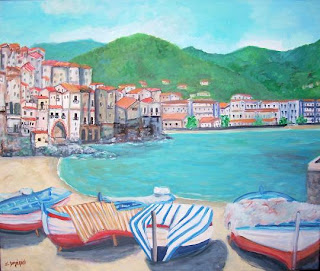
Cefalu'is located on the island of Sicily about an hour outside of its biggest city, Palermo. Upon walking into this town we, were awe-struck by the natural beauty and sheer vibrancy of the city.
Walking through the streets of this historic town is like taking a lesson in life and in history.
Cefalu'has so many beautiful sites to be seen. Must see is the Cathedral of Cefalu is the town’s main draw, and began life in 1131. The exterior of the building is extremely well preserved, and is instantly recognizable due to its large matching towers that flank the front porch. Built in the Sicilian Romanesque style, the interior houses a respectable collection of Byzantine art. There are a number of other churches to visit in the historic city, with the 16th Century pair of the Santa Maria dell’ Odigitria and the Santissima Annunziata just two of the fine examples of Baroque architecture. Also go to La Rocca to climb for the views.
Cefalu'has one of the best public beaches that we visited in all of Sicily. It’s clean sand and clear water makes it a popular beach, so be prepared for crowds.
Attractions
La Rocca Cefalu
Read more at: http://www.travelpod.com/ad/La_Rocca-Cefalu
Travel blogs from La Rocca:
- "Shona's sweet tooth satisfied we still had a couple of hours remaining before our train back to Palermo, so we decided to climb La Rocca, up an enormous stair case (The Salita Saraceno) winding up through three tiers of the cities walls, a "
- "Georgia and I decided to push on for the highest point of La Rocca, the castello"
Read these blogs and more at: http://www.travelpod.com/ad/La_Rocca-Cefalu#blog_content
Photos from:
- Cefalu, Sicily, Italy
Photos in this video:
- "View from La Rocca along the coast line" by Dinoshona from a blog titled "Cefalu, Cefalu..."
- "View from the Kastello, La Rocca Cefalu" by Guykb from a blog titled "Cheerful Cefalu"
- "Diana in her temple, La Rocca Cefalu" by Guykb from a blog titled "Cheerful Cefalu"
- "La Rocca looming above Cefalu" by Dinoshona from a blog titled "Cefalu, Cefalu..."
- "View from 'La Rocca'" by Rbartorillo from a blog titled "Cefalu"
- "Climbing La Rocca" by Guykb from a blog titled "Cheerful Cefalu"
- "Back of La Rocca" by Rbartorillo from a blog titled "Cefalu"
- "La Rocca" by Juneauwoman from a blog titled "Climbing La Rocca -The Rock"
Painting By: Teresa Dominici, Year: 2009, Acrylic on canvas, the original is Sold.
Rotella is a comune (municipality) in the Province of Ascoli Piceno in the Italian region Marche, located about 70 km south of Ancona and about 11 km north of Ascoli Piceno.
Ascoli Piceno is a town and comune in the Marche region of Italy, capital of the province of the same name. Its population is c. 51,400.
Geography
The town lies at the confluence of the Tronto River and the small river Castellano and is surrounded on three sides by mountains. Two natural parks border the town, one on the northwestern flank (Parco Nazionale dei Monti Sibillini) and the other on the southern (Parco Nazionale dei Monti della Laga).
Ascoli has good rail connections to the Adriatic coast and the city of San Benedetto del Tronto, by highway to Porto d'Ascoli and by the Italian National Road 4 Salaria to Rome.
History
Ascoli was founded by an Italic population (Piceni) several centuries before Rome's founding on the important Via Salaria, the salt road that connected Latium with the salt production areas on the Adriatic coast. In 268 BC it became a civitas foederata, a "federated" city with nominal independence from Rome. In 91 BC, together with other cities in central Italy, it revolted against Rome, but in 89 BC was reconquered and destroyed by Pompeius Strabo. Its inhabitants acquired Roman citizenship, following the developments and the eventual fall of the Roman Empire.
During the Middle Ages Ascoli was ravaged by the Ostrogoths and then by the Lombards of King Faroald (578). After nearly two centuries as part of the Lombard Duchy of Spoleto (593-789), Ascoli was ruled by the Franks through their vicars, but ultimately it was the bishops that gained influence and power over the city.
In 1189 a free republican municipality was established but internal strife led dramatically to the demise of civic values and freedom and to unfortunate ventures against neighboring enemies. This unstable situation opened the way to foreign dictatorships, like those of Galeotto I Malatesta (14th century), initially recruited as a mercenary (condottiero) in the war against Fermo, and Francesco Sforza. Sforza was ousted in 1482, but Ascoli was again compelled to submit to the Papal suzerainty. In 1860 it was annexed, together with Marche and Umbria, into the newly unified Kingdom of Italy. SOURCE :WIKIPEDIA