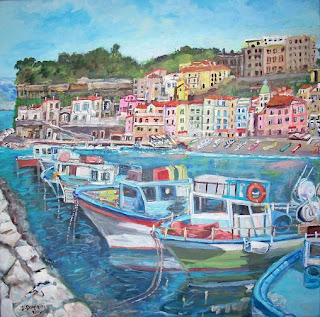
This isSorrento’s largest harbor and has long been home to a fishing fleet of traditional wooden boats.
Painting by: Teresa Dominici, Acrylic on canvas, 25"x25", (63x63 cm), Year: 2014, Title: Port of the Marina Grande in Sorrento
Marina Grande is a small traditional fishing port that sits underneath the limestone cliffs on which the old town of Sorrento is perched.
Port of the Marina Grande fishing was the main source of living of the people in this town. Today, fishermen can still be found in Marina Grande sitting and mending fish nets with their bare hands.
Despite its name, Marina Grande (large marina) is actually the smaller of Sorrento’s two main harbors. It is also the older marina.
In this program, we explore Sorrento's back streets, taste traditional Italian food, drive along the dramatic Amalfi Coast to catch some breathtaking scenery, learn the history behind the tourist shops of Amalfi, stroll in the shadow of Greek temples at Paestum, and sail to the Isle of Capri to enter the fabled Blue Grotto.
Medium: Acrylic on canvas, Size: 24"x18" (60x45cm), Year: 2012, Sold.
The island of Capri is absolutely beautiful and worth seeing, it was our second trip there.
Capri is only four miles long by two miles wide and very mountainous. The highest point is almost 600 metres above sea level and can be shrouded in cloud while the rest of the island enjoys the hot Mediterranean sun. There are many caves and impressive cliffs throughout this hilly island.
Here is a list of some of the famous sighting to see on the island of Capri:
Anacapri is the second biggest settlement on the island, and not so infested with ‘the glamorous scene’ as Capri town is. Must see is the Casa Rosso, a free museum located in an historic house which you can see the permanent exhibition of paintings glorifying the beauties of Capri island as well as Roman statues found in the Blue Grotto.
The Church of San Michele in Anacapri is famous for its beautiful majolica floors showing the scene of Adam and Eve’s expulsion from Eden.
The Natural Archis believed to have been formed from a
cave after an earthquake more than 2 million years ago. Its shape has changed
over the centuries due to rain and wind erosion. The arch measures some 200
metres high and can be located at the eastern side of the island.
The Museum-House of Villa San MicheleisAnacapri's most visited tourist attraction and is located just a few meters from Piazza Vittoria, central square of Anacapri, at the end of a characteristic shopping street and enjoying breathtaking cliff edge views over Capri.
The Blue Grotto is probably the most famous natural attraction of the isle of Capri.
On a great spur of rock almost directly above the Grotta Azzurra, Tiberius' Villa Damecuta is one of Anacapri's most visited sites.
The summit of monte Solaro is the highest point of Capri (589 meters/2062 feet) and provides breathtaking views over the bay of Naples and Salerno.
Migliera an enchanting pathway which winds its ways through woods and vineyards to one of the island's most spectacular viewing points.
Augustus Gardens (Via Krupp) - Flower festooned terraces overlooking the Faraglioni, and a spectacular path carved into the cliffs.
Faraglionithree massive sea stacks sculpted by the wind and sea, and the symbol of Capri.
Marina Piccolathe bay home to famous beach clubs and fish restaurants with view of the Faraglioni.
Marina Grandethe busy port of Capri offers visitors their first taste of life on the magical island.
Capri's Blue Grotto, a sea cave with glowing blue water, shining with a brilliant light. Other sights include the communities of Anacapri, Capri and Marina Grande.
Ravello è una delle cittadine più belle della costiera. Grazie alla sua
posizione privilegiata in alto si può ammirare un paesaggio meraviglioso
e il paese è veramente tenuto bene e curato.
Non limitatevi a godere solo del fantastico paesaggio, perché c'è tanto
da vedere: Villa Rufolo, Villa Cimbrone, il Duomo e tante altre Chiese
sono i luoghi da non perdere durante una visita in città.
"Nestled against the steep slope of a cliff along the spectacular Amalfi Coast, the ancient town of Ravello included in the province of Salerno. Because, in addition to magnificent scenery offered by the medieval streets of the city and the beautiful landscapes that form the backdrop, Ravellois alwaysmotivated by intensecultural activity, boasting a calendar of
eventsextraordinarily rich, whose climaxis, of course, the prestigiousRavelloFestival,the multifacetedexhibitionthat animates thehistoric sitesof the cityforalmostthe entire year.
Ravelloenchantsfirst of allfor
the exceptional beautyof the landscape:theterraces overlookingthe cliffoverlookingthe
gardensfacing thecliffand the deep greenand transparent,
villas and monuments.
LocatedinBishop'sSquare, next to the Cathedral, stands
the century VillaRufolo, whose towerstillseems to
lookcarefullythroughout the
city. Builton behalf of therich familyofRufolo, traders at
the timeknown and powerfulenough
to bementionedin the Decameron,
the building passed successivelypassed
from hand tohanduntil it wassoldtothe
nineteenth centuryScottish noblemanFrancis Neville, who workedrestoration,making itasstillseen.The
villarevealed in thearchitectural
elementsof severalstrong
influenceof Arab culture,particularly
in the importantMoorish cloisterstructuredwith double loggiaandporticoacutearch, adorned with gracefulcarved decorations, andraised courtyard. Thegreatestwonderof VillaRufoloareblooming gardens, favorite place ofRichardWagner,where today,in
theflowering terraces andsteeptowardsthe blue seaof the Amalfi Coastand the Gulf ofSalerno,the Wagner Festivalis celebratedinmemory
to thegreat German musician,one of the initiativesthat has made
Ravellothe "Cityof
Music"par excellence.
Another beautifulandfamousbuildinginRavello isVillaCimbrone, built on arock overlookingthe Gulfof Salerno, in the
place where once stooda Roman villa,later convertedfarmhouseinagriculture.It isa building designedand rebuilt fordouble hand, Italian and English,the manufacturer'sNicolaMansiandtheEnglish lordWilliamBeckett,
whomagicallytransformedthe house intoruinin
a sort ofgarden of wonders, with a magnificent interplay betweenthe rigor of theItalian style and thelushsettingofan English
nobleman, a passion for botany. The
result, charming and strongly suggestive,is a mix oflocaland
ethnicstyles, a meeting point between
theold villaand the gallery ofantiques,almost adiaryof an explorertransformedinto a dwelling.The large groundsof the villa,in particular, isa labyrinthofGothic
andclassical, including statues,
temples, bridges, grottosand fountainsto reachthe fantasticBelvedereof Infinity,a
huge roof terracefacing thesublimeviewthe open seaof the Gulf ofSalernoandthe Amalfi Coast,a
placemuch lovedby the writerGoreVidal.Today
the villais usedto hostpublic and private events."
Ischia, the biggest island in Campania is placed opposite the gulf of Naples. It’s of volcanic origin and presents a prevalently montainous territori; its hightest montain is Epaneo.The coast are interposed by enchanting coves and wonderful bays.Ischia is called “Green Island” for its Mediterranean vegetation and “health Island” for the thermal baths. The island ,with its nature, culture, traditions, history and myths, is one of the most famous destinations for tourists from all over the world.
Sorrento is situated along the southern side of the Naples gulf, in a splendid scenic position. Its name comes from the mermaids, the legendary creatures which melodies bewitched the sailors. It was the favorite holiday place of the roman aristocracy that built there some grandiose villas and in the XIX century it became a favorite destination for artists, men of letters and musicians from all over the world who were inspired by the beauty of its panoramas and by the pleasantness of its landscapes. Sorrento is provided with equipped bathing like this of marina Grande.
Here is an original Napolitan version of Torna Surriento in true Napolitan dialect. "Surriento" is spelt this way as in Napolitan dialect.
The photo's, I took of my home town Sorrento on my many, regular visits. When you visit Sorrento your heart melts, leaving you wanting to Come back to Sorrento.
Naples is the capital city of the Campania region and the Province of Naples. Its ancient name was Neapolis, that is "new city". Its metropolitan area is the second most populated in Italy and one of the largest in Europe.
The town of Naples, (Napoli in Italian) took its name from the Greek word for new city, Neapolis. It is far from that. It is an old port town, with a lot of charm and some great museums, artistic and cultural traditions and gastronomy.
The historic city is characterized by many churches. You often find several of them in one street among Baroque style palazzi of aristocratic families and antique residences. Naples’s most important church is the San Gennaro (St. Januarius) Cathedral, where each year the famous Miracle Blood ceremony takes place. The Gothic churches, San Lorenzo Maggiore and San Domenico Maggiore, as well as the Baroque church, Gesù Nuovo , are worth a visit.The San Severo Chapel is fascinating because of its mysterious anatomic machines, two skeletons that are inexplicably covered with a system of fossil veins and arteries. In addition, you can see beautiful Baroque sculptures from the 17th and 18th century. A wonderful place to take a rest is the garden of the Santa Chiara Convent with its columns, little benches, and walls that are wainscoted with beautiful colorful majolica. On Via San Sebastiano, you can find music stores that, because of their vicinity to the conservatory, still sell mandolins. Nearby is the street of the booksellers, Port’ Alba, where you can buy delicious pizza at the street counter of the pizzeria of the same name and eat it right away.
A trip to the underworld, which is entwined by mysterious legends, is a special experience and has in the meantime become an important part of the city tours.Underneath modern Naples is an 80-kilometer-long labyrinth of caves hidden, which lies up to 40 meters underground. The individual caves were created when people mined the yellow tufa that was used to build the houses that stand above each of these caves.
Via Partenope is the beginning of the seafront road where Castel dell’Ovo (Egg’s Castle) rises on an island that is connected to the mainland. From the castle, you have a fantastic view of the Mount Vesuvio as well as the quarters Mergellina and Posillipo.
At the picturesque marina you find excellent restaurants and bars. A little further, Villa Comunale, a big park with palm trees, chalets, and beautiful fountains, extends along the famous seafront road, Via Caracciolo. The walk along the seashore to the touristic harbour of Mergellina is very romantic. Close by the harbour, fishermen sell their freshly caught fish.
Posillipo is probably Naples’s most beautiful and exclusive quarter. On a hill, there are gorgeous villas tucked away between trees, and small, intricate trails lead to the sea. From the steep coast, you have the most breathtaking panoramic views.
Virgiliano Park is located at Naples’s furthermost tip, Capo Posillipo. From there, you can enjoy wonderful views over the city, the Gulf of Naples and Pozzuoli as well as the islands Capri, Ischia, and Procida. It is a terraced park with many blooming plants and trees. This is the place, where artists paint the well-known panorama of Naples. The park is open 14 hours a day and is lighted during the evening.
Easy to reach is the Vomero, a quarter whose hill and castle, Castello Sant'Elmo, rise over Naples and offer a beautiful view over the sea, Mount Vesuvio, and the lively city. At the foot of the castle is the convent complex of Certosa di S. Martino , which houses the National Museum of San Martino with one of the largest exhibitions of nativity scenes worldwide. From the terraced gardens, you have a stunning view of the Gulf of Naples.
“O’ caffè” represents more for the Neapolitan than just an aromatic and stimulating beverage. A Neapolitan is generally very critical when it comes to judging a coffee. It is said that Naples has the best Italian caffè, even though “de gustibus non disputandum est” or “There's no arguing taste”. When Neapolitan say caffè, they always mean “a tazzulella 'e cafe”, a coffee in an espresso cup.
Pizza is a worldwide phenomena that has ancient roots. However the original and best pizza still comes from Italy in traditional ovens still used in placed like Naples.